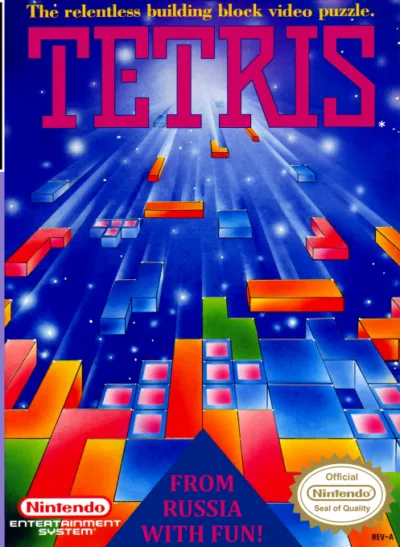

THE PLAYER'S GUIDE
About Tetris
Nintendo’s NES Tetris turns seven simple shapes into a steady exercise in judgment: where does this piece belong, and how much room can you afford to leave? Choose an endurance run or a finite challenge, then settle into a puzzle whose pressure comes from making useful decisions while the pieces keep falling.
The game
Build rows, preserve space
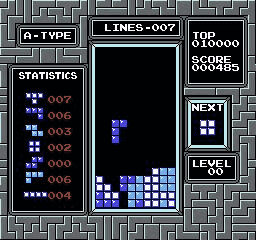
The playfield is your entire arena. Each falling piece consists of four squares; arrange them to fill horizontal rows without gaps. Completed rows disappear, and blocks above descend into the space. The run ends when the pile reaches the top. Every placement therefore has two jobs: making progress now and leaving workable space for later.
Two kinds of pressure
A-TYPE pursues a high score over an open-ended run, with the falling speed increasing as play continues. B-TYPE asks you to complete 25 lines at a fixed speed. Its separate HEIGHT setting adds random blocks at the bottom before you begin, turning the opening position into a cleanup problem. In B-TYPE, the LINES counter counts down toward completion.
This edition
Nintendo’s NES edition
This guide covers Nintendo’s NES version. Its setup screen offers three music selections and an OFF option. Both game types also accept names of up to six letters for their top three scores, but those records are erased when the original console’s power is switched off.
Start here
- Give yourself thinking time
For a first session, choose A-TYPE and LEVEL 0. The lowest starting speed gives you room to learn the shapes before faster decisions become necessary.
- Practice both rotation directions
Use the first few pieces to try clockwise and counterclockwise turns. Learn how each shape changes orientation before concentrating on a high score.
- Try a controlled second challenge
After your opening run, try B-TYPE with a low LEVEL and HEIGHT 0. Then raise HEIGHT while keeping LEVEL unchanged to practice handling a more crowded board without also increasing the speed.
Original controls
These are the original game's controls. For keyboard, controller and touch settings in this player, see Controls & help.
- NES + Control Pad: Left / Right
- Move the falling piece sideways. The pad also selects setup options.
- NES + Control Pad: Down
- Make the current piece fall faster.
- NES A button
- Rotate the piece 90 degrees clockwise per press.
- NES B button
- Rotate the piece 90 degrees counterclockwise per press.
- NES SELECT button
- Hide or restore the NEXT piece display during play.
- NES START button
- Start the game; during play, pause or resume.
Playing tips
- Keep the preview visible
Check NEXT before committing a piece. Knowing the following shape lets you judge whether a tempting placement leaves somewhere useful for it to go.
- Protect access to gaps
Avoid covering an unfinished space with another piece. Keeping gaps reachable makes later repairs easier and reduces the amount of clearing needed to uncover them.
- Earn bigger clears when there is room
At LEVEL 0, four separate singles earn 160 points; a four-line TETRIS earns 1,200. Build toward larger clears when the board allows it, but take a smaller clear when the stack needs breathing room.
Secrets
Reveal secrets and codes
Start ten levels faster
On the LEVEL setting screen, hold the NES A button and press START. The starting falling speed becomes the selected LEVEL plus 10. In B-TYPE, the completion bonus still uses the original selected LEVEL.

 Your next world.

Player memories
Remember Tetris? Share a memory or a tip for other players.
The next memory could be yours.
Sign in to leave a memoryLoading the memory card…